ProtecTor EC
Ambient and warm air stream acting as door screening across large doorways.
- Heating
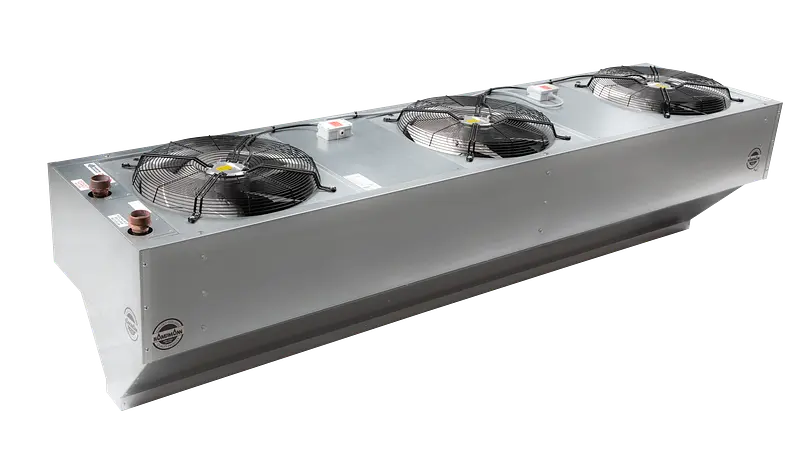
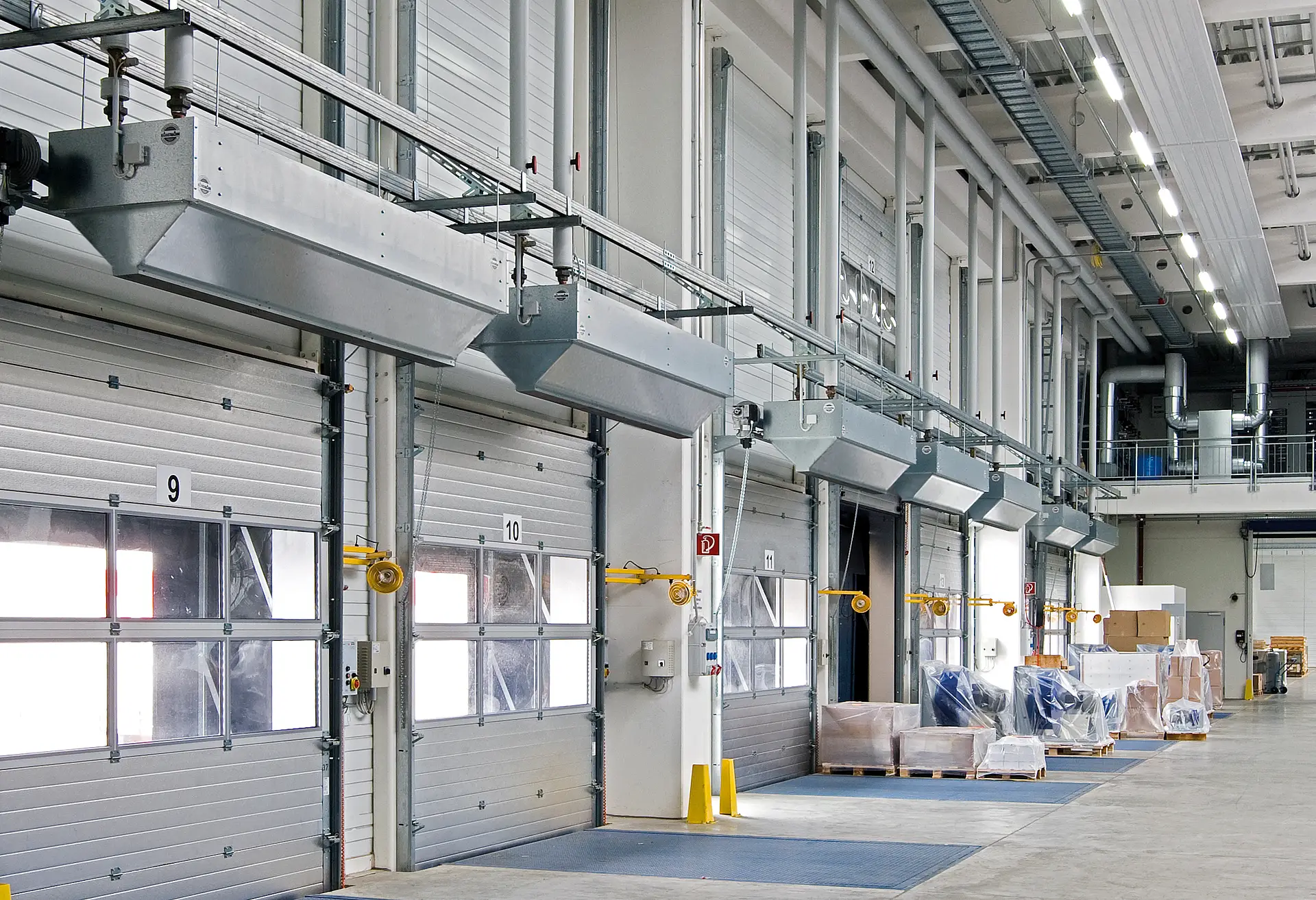
The design and location should be selected taking into account the structural conditions and traffic routes.
Horizontal installation above the door is the most frequently used design. It allows the entire door opening to be covered evenly. At the same time, the unit is well protected against mechanical damage in this position, e.g. from industrial trucks.
If the space above the door is limited, the upright installation variant can be selected. In this case, the air curtain is installed to the side of the door - on one or both sides, depending on the door width.
| Version |
|---|
| horizontal (above the door), connection on the right |
| Horizontal (above the doorway), connection on left |
| Standing (to the left of the doorway) |
| Standing (to the right of the doorway) |
There are basically two types of heat exchanger available, which are selected depending on the application area:
Copper/aluminum heat exchanger
This variant offers high thermal efficiency and is particularly suitable for applications under normal environmental conditions. Typical application areas are workshops, logistics areas or production halls with low levels of air pollution.
Galvanized steel heat exchanger
This version is preferred when the room air is heavily contaminated and the heat exchanger needs to be cleaned regularly. The robust design allows mechanical cleaning.
Compared to the copper/aluminum version, the thermal output is reduced, but it offers greater resistance to external influences.
| Heat exchanger model |
|---|
| copper/aluminium |
| steel galvanised |
| without heat exchanger |
We offer various solutions for the control and regulation of our units, which can be used depending on the application and requirements:
Electromechanical control
This variant is ideal for simple applications. All integrated actuators are factory-wired to terminals and can be connected to our electromechanical accessories such as thermostats or external controllers.
| Control option |
|---|
| electromechanical |
| electromechanical with repair switch |
The units are available in different lengths. The units must cover the entire door.
If the ProtecTor is selected as an upright version, the length refers to the door height.
| Max. door width or height |
|---|
| 2000 mm |
| 3000 mm |
| 4000 mm |
| 5000 mm |
The throw describes the distance over which the air volume flow of an air curtain system ensures effective shielding between indoor and outdoor air. It is therefore a central criterion when selecting the right unit.
For horizontally mounted systems (above the door), the throw corresponds to the distance from the air curtain to the door threshold. The decisive factor here is not the actual door height, but the actual installation height, as the unit is often installed above the door opening for structural reasons.
For vertically mounted systems (to the side of the door), the throw describes the distance to the opposite side of the door. Here too, it is not just the door width that is decisive, but the actual positioning of the air curtain system.
| Throw |
|---|
| - |
| - |
| - |
Extremely unfavorable operating conditions, such as
can impair the effective shielding provided by door air curtains.
Additional measures may be required here, e.g. for pressure equalization in the room.
When placed above the door, the equipment must be installed so that the air outlet rectifier is placed as close as possible to the door opening.
For larger distances:
For both horizontally mounted and upright devices, a distance of at least 320 mm must be provided above the motor protection cage.
The maximum throwing distance results from the maximum penetration depth of the air jet in the goal area. The maximum discharge height or distance depends on
The maximum mounting heights specified in the technical data apply to free-blowing operation including the blow-off nozzle in the highest switching stage.
Results per page
Results per page
Page 1 of 0
Results per page
Results per page
Page 1 of 0